

From Screenplay to Screen : The Complete Film Production Process in the USA

A screenplay is where a film begins, but it is certainly not where the hard work ends. A few hundred pages—or sometimes just a brilliant idea—must eventually become locations, performances, sets, schedules, camera setups, sound, editing, and a finished story that audiences can actually watch.
The complete film production process in the USA is a carefully connected chain of creative and operational decisions. From development and financing through casting, principal photography, post-production, and distribution, every stage has a job to do. Skip one, rush another, and the consequences usually show up later when fixing them costs considerably more.
This is where an experienced film production company in the USA can make a meaningful difference. Professional production teams bring together creative direction, planning, technical expertise, talent, logistics, and project management so that an ambitious idea can survive the realities of production.
The Screenplay Is the Blueprint, Not the Building
A screenplay establishes the story, characters, dialogue, locations, and action. It gives everyone a common creative reference point, but it does not answer every practical question.
Producers must determine how the story can actually be made. That means considering budget, schedule, casting, locations, crew requirements, production design, equipment, and countless smaller decisions that eventually become one large production plan.
Great Filmmaking Needs Creative and Practical Thinking
The strongest productions balance creative ambition with disciplined execution. A director may imagine an extraordinary sequence, while the producer asks how many days it requires, what it costs, and whether the location is available.
Neither side is the enemy. The best production teams find the solution that protects the story without allowing the practical side of filmmaking to quietly take over.
1. Film Development : Turning an Idea Into a Production
The first stage of the film production process is development. This is where an original concept, screenplay, adaptation, or commissioned story is shaped into a viable project.
Development can involve several rounds of script revisions, research, rights negotiations, character development, story structure, and early budget discussions. Producers may also begin identifying directors, potential cast members, financing partners, or distribution opportunities.
This stage is often longer than outsiders expect. A project can spend months or even years in development before receiving approval to move forward.
2. Financing and Budgeting : Giving the Story a Practical Framework
Once the creative direction is established, the project needs financial structure. Film financing in the USA can come from studios, independent investors, production companies, co-production arrangements, grants, distribution agreements, and other sources.
The budget must account for far more than the obvious expenses. Depending on the scale of the project, producers may need to plan for:
Cast and crew salaries
Locations and permits
Sets, props, wardrobe, and makeup
Camera, lighting, and sound equipment
Transportation and accommodation
Insurance and legal costs
Post-production and finishing
Marketing and distribution
Budgeting is essentially a series of creative priorities expressed in financial terms. If a particular sequence is central to the story, the production may decide to protect funding for it while finding savings elsewhere.
An experienced film production company USA understands that a budget is not simply a spreadsheet. It is a roadmap showing where resources can have the greatest impact on the finished film.
3. Pre-Production: Building the Plan Before Cameras Roll
Pre-production is where the screenplay becomes a detailed production blueprint. It is also where experienced teams can prevent a remarkable number of future headaches.
Producers, directors, department heads, and coordinators work through the practical requirements of the script. This includes casting, location scouting, production design, scheduling, rehearsals, equipment planning, permits, transportation, crew hiring, and safety considerations.
One of the most important tasks is creating the shooting schedule. Films are rarely shot in screenplay order. Instead, scenes are grouped according to locations, cast availability, lighting requirements, equipment, and other logistical considerations.
A character might appear in scenes spread across half the screenplay, for example, but those scenes may all be filmed together if the actor and location are available on the same days.
This is one reason professional Film production services can be valuable. Structured planning allows creative teams to spend more time focusing on storytelling and less time untangling preventable logistical problems.
4. Casting and Production Design: Giving the Story a Physical Identity
At the same time, production designers and their teams develop the visual environment. Sets, props, costumes, colours, architecture, and locations all contribute to the film's identity.
These elements often communicate information without dialogue. A character's home can reveal their personality. A carefully chosen costume can establish a period or social background. A location can make a scene feel intimate, threatening, isolated, or expansive before anyone says a word.
5. Principal Photography : When the Film Is Captured
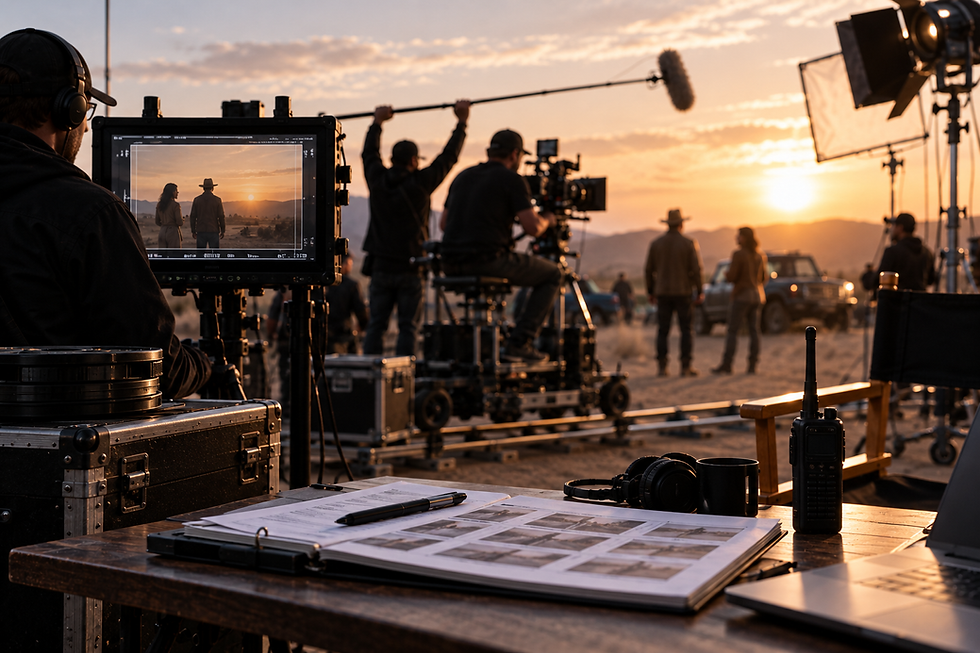
Principal photography is the stage most people associate with filmmaking. This is when the cast performs and the crew captures the scenes planned during pre-production.
Behind every camera is a large network of departments working simultaneously. Directors guide performances and creative decisions, while cinematographers shape the visual language. Sound teams capture dialogue and production audio. Lighting crews create the required atmosphere. Art, wardrobe, makeup, and production teams maintain continuity and keep the schedule moving.
A shooting day can be highly structured. Scenes may need to be completed within strict time windows because locations, actors, equipment, or permits are only available for a limited period.
6. Post-Production: Shaping Raw Material Into a Finished Film
When filming ends, the project enters one of its most creative stages: post-production.
Editors review and organise the captured material before assembling scenes and building the overall narrative. Directors and producers review cuts, assess pacing, refine performances, and make decisions about what stays, what changes, and what disappears completely.
Post-production can also include:
Editing and picture finishing
Colour correction and grading
Sound editing and mixing
Music and score integration
Visual effects
Motion graphics and titles
Technical quality control
This stage can dramatically change the emotional impact of a story. A scene that felt slow during production may become effective after editing. A performance may become stronger when paired with a different reaction shot. A sequence that looked essential in the script may eventually be removed because the finished film works better without it.
For a deeper look at how the complete process works, readers can also explore Film Production Company USA.
7. Sound, Music, and Final Finishing
Sound has an enormous influence on how audiences experience a film, even though viewers often notice it only when it is poorly handled.
Dialogue must remain clear. Background sounds need to feel natural. Music should support the emotional direction rather than compete with it. Sound effects can make environments feel authentic, while deliberate silence can sometimes create more tension than a full musical score.
Final finishing also includes colour grading and technical preparation. Colourists establish visual consistency across scenes, while finishing teams ensure the final master meets the requirements of its intended distribution format.
8. Review, Revisions, and Final Approval
Before release, the completed film may go through internal screenings, test audiences, producers, distributors, or other stakeholders.
Feedback can reveal pacing issues, unclear story points, technical problems, or moments that simply aren't landing as intended. Revisions may involve trimming scenes, changing sequences, adjusting sound, refining visual effects, or making broader editorial decisions.
This process isn't necessarily a sign that something went wrong. Film is collaborative, and fresh eyes often identify things that become invisible after months of working on the same material.
9. Distribution : Taking the Film to Its Audience
A finished film still needs a path to viewers. Distribution can involve theatrical releases, streaming platforms, television, festivals, licensing arrangements, educational channels, or other specialised outlets.
The appropriate strategy depends on the project's audience, genre, budget, commercial objectives, and existing relationships.
Distribution requirements can also influence production decisions. Deliverables may need specific technical specifications, subtitles, captions, artwork, trailers, promotional material, or alternative formats.
Thinking about distribution early helps prevent expensive last-minute changes and gives the production a clearer commercial direction.
10. Marketing and Release: Completing the Journey
Making a film does not automatically make people aware of it. Marketing creates the bridge between the finished project and its intended audience.
Depending on the project, promotion can include trailers, posters, press coverage, festival appearances, interviews, social campaigns, screenings, partnerships, and targeted advertising.
Independent films may rely heavily on festivals and community engagement, while larger productions can have extensive campaigns running months before release.
Final Thought
The journey from screenplay to screen is rarely simple, and that's precisely what makes professional filmmaking so impressive. Every finished scene represents decisions made by writers, producers, directors, performers, designers, technicians, editors, and many others working toward the same creative destination.
The best productions respect both sides of the equation: the imagination required to tell a compelling story and the discipline required to make that story real.
If you're ready to develop a project and want to discuss your production requirements, contact Dela Entertainment to explore the next steps with an experienced creative team.
FAQ - Film Production Company in USA
What does a film production company in the USA do?
It manages key stages of filmmaking, from development and pre-production to filming and post-production.
How long does film production take?
The timeline varies by project, but larger productions can take months or even years from development to release.
What are the main stages of film production?
The main stages are development, financing, pre-production, filming, post-production, distribution, and release.
How much does film production cost in the USA?
Costs depend on the project's cast, locations, crew, schedule, production scale, and post-production requirements.
Why hire a film production company?
A professional team provides the planning, creative expertise, technical skills, and coordination needed to bring a screenplay to the screen.


Comments